This week I thought I’d write about what led me to seek an Autism Spectrum Disorder (ASD) diagnosis. The short version is that it happened because I read Katherine May‘s Wintering. But that lacks context.
I pursued my diagnosis in 2021, at the culmination of a years-long existential meltdown. I’m not exactly sure when the meltdown started. Maybe at the end of my PhD program, when I stepped off the brutalizing academic treadmill into an unstructured and undefined future. Maybe before that. I know now, with the benefit of hindsight, that after the program I was completely adrift, depressed, and sometimes suicidal. But I was going through the motions and not confronting this at all. My partner at the time knew that something was very wrong. He started confronting me, and gradually it all came out. At first I just admitted that we had some relationship issues to work on. But he could tell that wasn’t really the core problem, so he kept digging. After a while I admitted to being depressed. We discussed it as a contextual thing, really post-PhD related. But in talking about my depression, and trying different things to alleviate it, we discovered that my depression was not really contextual. At least not at a superficial level. It wasn’t alleviated by exercise, writing, eating better, sleeping better… There was something at work in a deeper place, and it was sabotaging all of my attempts to feel better.
I eventually realized what it was. At first it looked like a total ambivalence and disinterest in everything. Alienation, disconnection. But underneath that, what I found was rage. White hot rage, directed at seemingly everything. I was controlling it only through avoidance and disconnection from everything. I was filled with rage at …. something… but I had found a way to contain and carry that rage in a vessel that looked like disinterest. Like a, “Fuck it all, I don’t care anymore. I give up.”
At this point in the process I was in talk therapy, and my therapist helped me uncover what some of the rage was about. At a very fundamental level, I did not feel like myself. It wasn’t just that I didn’t like myself, or know myself very well–it was that I literally didn’t recognize myself or feel like I understood myself at all. I looked at my life and it felt like it belonged to someone else. It was so much like the Talking Heads song, “Once in a Lifetime”: How did I get here? Whose life is this? Where is my life? The life I am supposed to be living? It felt like that life had been taken from me–that I had been taken from me. But I didn’t yet understand why I felt this way. I just knew that it was the source of my rage, and understanding it was the way forward.
It was in this context that I read Katherine May’s Wintering. My best friend recommended it to me, recognizing that the book describes a life phase that I was maybe in the midst of: one of sitting with and confronting the end of things, before new paths forward can emerge. It was affirming. But that was not what interested me most about the book. Instead, I became fixated on May’s descriptions of how she experiences the world at a sensory level–particularly after she reveals that she had recently been diagnosed with ASD. I remember thinking, “She experiences the world like I do. And she has ASD. Huh.”
I started reading about autism in girls, and how psychiatry is beginning to understand it better–and how it can differ in the ways it manifests in girls and boys. I had had a particular idea of what autism was, even in girls (mostly based on Temple Grandin), but I began to relax that understanding to include the experiences of other autistic women I was reading about. And I finally began to understand many of my own experiences, totally mystifying before but clearer now within the context of undiagnosed ASD or neurodivergence. It was revelatory but also shocking. It was like the optometrist switching between Lens 1 and Lens 2, if Lens 1 was severe astigmatism, nearly nonsensical, while Lens 2 was 4K Ultra HD. A thousand things about me suddenly made more sense. I went from a person who didn’t understand herself at all–despite being 40 years old–to a person who finally had some self-clarity.
And I understand now why it feels like, at some point, my life became someone else’s life, and I became someone else who never really felt like “me.” The person I was supposed to be, the life I was supposed to have, was taken from me. From a very young age I faced relentless, ubiquitous pressure from all sides to become someone else, to give up on my dreams, to live a life very different from the one I would choose. And that pressure had succeeded. I had lost, not even realizing what I’d lost until decades later. Of course I was filled with rage; who wouldn’t be?
As horrible as it has been, the pandemic has allowed me the flexibility to make dramatic changes in my life in the wake of these realizations. It has given me the ability to stop, turn around, and try to find my way back to the path I want to be on. Right now I feel closer to my real life, my real self, than I have since I was very young. And that feels both scary and really good. I don’t want to die anymore. I want to live, and keep getting closer. I know that I’ll never be the specific person that I would’ve been, if I’d grown up in a truly supportive environment and society. But I’m optimistic that I can recover enough of that person to integrate her with the person I’ve become, into someone who can feel fulfilled and maybe even love herself.
I know a number of people my age, particularly women, who are also currently exploring whether neurodivergence/undiagnosed ASD explains their life experiences. Some of them have approached me asking similar questions: How did I go about getting my diagnosis? Why did I get the diagnosis in the first place, if the only real result is self-knowledge, and not treatment or services–which are not really available for adults with ASD at this point. (We’re only now starting to confront, as a society, the fact that ASD isn’t confined to childhood, and it has profound effects on the adults those children become.) So I want to share my reasons and the process for getting my diagnosis, in case it helps others.
In terms of my motivation for getting a diagnosis: I was raised by a side of my family that had an unhealthy inner culture of self-diagnosis, hypochondria, and pseudoscientific beliefs. I have been making real progress in recognizing and confronting this, and the effect it has had on me, in recent years. And because of it, I knew that I needed an official medical diagnosis. I wasn’t going to be confident claiming ASD as part of my identity without the certainty of a medical doctor’s confirmation. So I found a Harvard-trained clinical psychiatrist who specializes in ASD.
After taking assessments and talking to her for a couple hours, she verbally diagnosed me with ASD. She also diagnosed me with ADHD; she says that these conditions often manifest together. (That has been a whole other revelation to me, one that I am also still processing.) I had to pay for her diagnosis out-of-pocket, because my mental health insurance would not cover it. But it was worth it to me, because I felt I needed to know for sure. And now I can process this self-knowledge in talk therapy at the very least, and maybe eventually there will be more resources available (and covered) for neurodivergent adults. I also know that I was lucky to have the means to answer this important question about myself. I recognize that not everyone who is contemplating neurodivergence/ASD as part of their identity has access to, or even cares about receiving, a medical diagnosis. But it mattered to me, and I was privileged enough to be able to access it.
As I expressed earlier, I felt profound pressure to learn how to pass when I was a child. I am also high-functioning, and a pathological people-pleaser. So it may be difficult for people in my life to tell how ASD is affecting me. What does my ASD look like? In a nutshell, a lifelong struggle with seemingly-inexplicable social norms and unspoken customs/expectations; misinterpreting social situations; not having a “filter”; interpreting everything literally; difficulty with certain types of humor; being quick to sensory overload; hyperfixation on certain personal interests; relying on particular bodily tics to comfort myself and maintain focus (i.e., “stimming”); a strong belief in justice and fairness that seems to exceed those around me; and a seemingly ever-present frustration and sometimes rage at feeling like I just don’t understand other people.
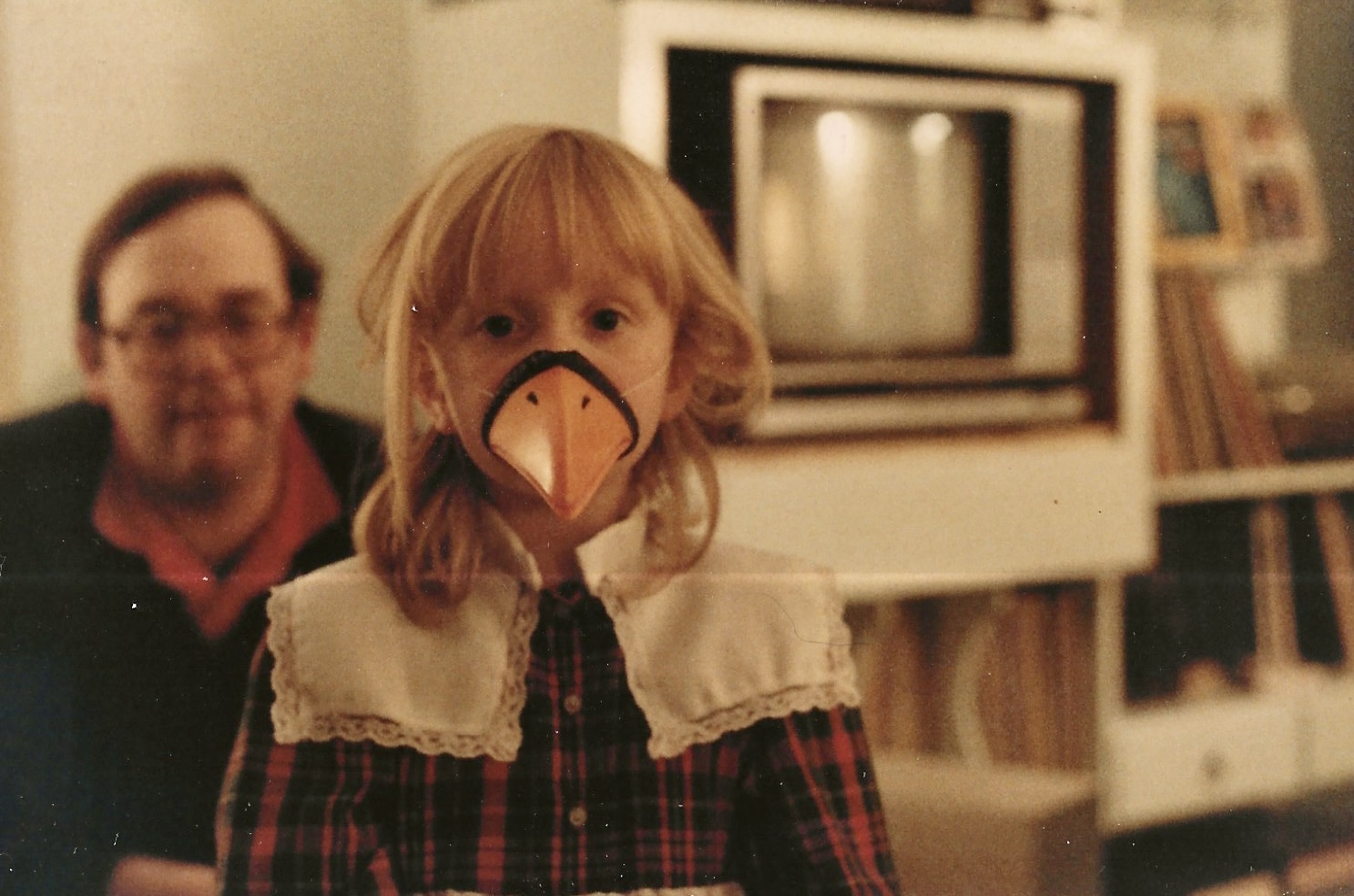
At this point in the process, I am focusing primarily on trying to unmask and feel more like myself–whoever that is. It remains maddeningly difficult to know who I “really am.” Partly because I’m not sure I even believe in a static, stable self that can be “discovered” or “known.” But also because I tried for so very long to hide (kill, really) the person I started out being. Most days it feels like my “original” self is just gone, and all that’s left is the messy shell of a person I constructed to hide her. I don’t know if it’s really possible to access her again, let alone invite her to take the reins. But I have optimistic days. And thankfully I have video of her, from our home movies now digitized. I have about 30 precious minutes that I’ve watched over and over. She is always singing and saying things in low, funny voices in the background, drifting in and out of conversations while clearly moving in her own little world, wanting attention on her own terms, messy-haired and … familiar. Maybe she is still here, somewhere.
One of my hopes is that, through trying to write about her, I can coax her back into the world.
 STUDIO