This post discusses disordered eating.
I’ve reached the age when my medical chart is starting to collect a fair number of conditions and disorders. Some of them are disruptive to my life, others not as much. But one condition was added to my chart in the last couple months that was quite a shock to me when I saw it. Earlier that day I had discussed with my psychiatrist my altered eating habits during the pandemic. A couple hours later, my After Visit Summary arrived and there it was in my list of conditions: “binge eating.”
I think I recoiled from my screen. No, I thought. That is not what I told her. I’m just eating a lot of ice cream. A few months into the pandemic, when I thought that maybe civilization was about to collapse, I had what I considered to be an epiphany: If I’m going to die or if civilization is going up in flames, I’m at least going to eat as much ice cream as I want in the meantime. And so I did. I didn’t imagine this–the ice cream eating and the pandemic–would continue for the next three years. But it has. There have been phases where I’ve restricted ice cream to about once a week, and phases where I have it almost every day. It comforts me. It’s a reward for making it through the week, or day. This is what I’d told the doctor. What she heard me describe was binge eating.
Yes, I did gain nearly 50 pounds in that first year of the pandemic, and it has not budged in the last two years. Yes, there are times when I worry about what the ice cream is doing to my body. I know it’s not “healthy.” I was raised around nominally “healthy” eating practices. I’ve been through nutritionist counseling. I’ve read Health at Every Size. I’ve read about Intuitive Eating. For the past three years, eating ice cream has felt intuitive!
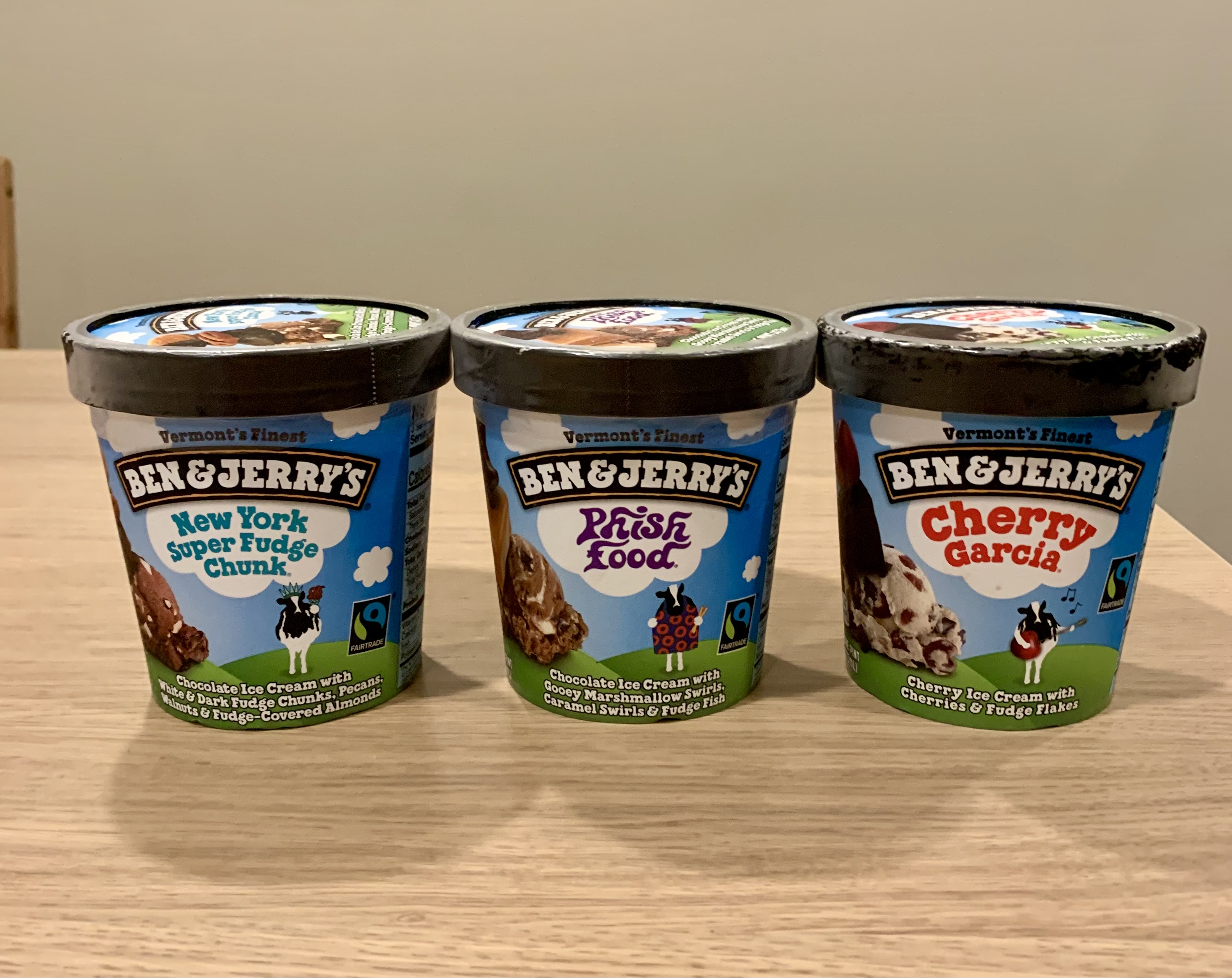
I grew up in an environment of food restrictions. We did not have the foods at home that my friends had. We were not really allowed to snack, because it was “unhealthy,” and I remember long desperate waits until the next meal. Occasionally we’d go on fad diets like the vegetable soup diet. Any kind of fat and refined sugar were very bad. But I loved ice cream. I would often tell myself, “When I’m an adult, I’m going to eat as much ice cream as I want.” That was literally the main thing I looked forward to. Back then ice cream was a rare treat. My mother would get out the little bowls and give us a single scoop. I would practice self-restraint, and wait until it softened and I could stir it into a smooth consistency and spoon it up. I called it my “medicine.” It was always a moment of pleasure when the world around me fell away, and I would kind of fall back into my body and feel whole. And then I would be scraping the bowl with my spoon, and the world would rush back in.

I remember when Ben & Jerry’s was first stocked in our small town grocery store. My parents brought it home as a treat, but would only let us have a small scoop at a time. “It’s too rich,” they explained. In high school, when I could borrow the car, I would buy a pint on the way home from school or work and sneak it into the chest freezer in the basement, hiding it underneath bags of frozen vegetables. After everyone went to bed I would sneak it into my room and consume the entire thing in a state of rapture. I’d wrap the empty container in paper towel and put it in my backpack, to discard somewhere away from the house. When I went to college, I would buy pints from the store in the basement of my dormitory, and keep them in the minifridge freezer in our room. But I was broke and gaining weight, so I tried to exercise self-restraint. I forced myself to develop the habit of only eating half at a time, and the practice of walking very quickly past the store’s freezer to avoid the temptation.
Then the year after I graduated from college I got very sick–the sickest I’ve ever been. I couldn’t keep any food in my body for nearly a month. They never figured out what it was, but now I think it was just my first and worst (to date) severe IBS attack. But the lack of explanation at the time really freaked me out, and caused me to radically experiment with dietary restrictions, so that it would never happen again. (It had to be food’s fault, and food restriction had to be the solution. Right?) I tried all the fad diets at that time, tapping into reserves of willpower I have rarely seen again. I restricted dairy, among other things, for a long time after this. Ice cream was forbidden; only a breakup or severe PMS could cause me to “slip.”
I went to graduate school a few years later at a highly-ranked program in California. Everyone was thin and wealthy, and ate like birds. I fell in unrequited love with one of them, whose “type” was skinny. I lost a lot of weight trying to fit in. My Midwestern body type was so out of place: my relatively wide hips and shoulders, my round arms, my fleshiness. I got a CSA share and tried to only eat vegetables, lean proteins, and very dark chocolate with little sugar content. But no matter how much weight I lost, it didn’t work. I was never going to be one of them–the East and West Coast Elites. I had obesity in my DNA, and it was happy to bide its time while I experimented with starving myself. I gave in. I got a “normal” boyfriend with two sons, and we ate like a “normal” American family. Processed meats and side dishes out of boxes, cheesy Mexican food and seasonally appropriate desserts. My weight crept back up.
Then the pandemic. The vow to eat whatever I wanted to eat, because Screw It. 50 pounds. Therapy. A “binge eating” diagnosis. She has even started talking about my ice cream eating as an “addiction.” I have very conflicted feelings about this.
Part of me agrees with her. But is this the same part of me that hates my body, wants to control it, feels aligned with and has internalized our cultural fatphobia ? Or is it the part of me that wants to be healthy and survive? Could it be both at the same time? How do I separate them? I really can’t tell. And then there’s the third voice. The one shouting:
Fuck. Them. All.
Eat. The. Ice. Cream.
Find pleasure where you can, and don’t overthink it. Some day you will die. Until then, eat the ice cream and feel happy.
I have a lot of body dysmorphia with this new 50 pounds. The body I’m used to having, the body I imagine or even see when I look down, doesn’t match the body I see reflected back at me in windows, photos, mirrors. When I see it I always think, “My worst nightmare was to have a body like this.” For the longest time in my family, I was the thin one. I believed that I would always be the thin one. And I admit that I was smug about this. I felt both superior and relieved that I had dodged the obesity gene. But that “privilege” has been eclipsed by the inevitability of aging and genetics. I also hadn’t realized how much I was starving myself in order to hold onto that “honor,” and that this method would have diminishing returns. Maybe the ice cream “binge,” in addition to coping, was also a semi-conscious hastening of what I knew deep down was inevitable. The body I have now is closer to the body I’m supposed to have. I’m just not used to it, because I’ve been going to extremes to prevent its existence.
I don’t know what to do about the ice cream. Moderation, combined with healthy behaviors in other areas, seems rational. I confess that I know very little about binge eating; my biases and assumptions about it are entirely derived from social norms and pop culture. I imagine it as something very extreme, that takes you over, and not as someone sitting down with a treat at the end of the day, always the same amount, a seeming habit and not an uncontrolled mania. But maybe “binge eating” encompasses my behavior as well. Maybe, like many things, it’s a spectrum of behaviors.
Or maybe my doctor is just wrong. Maybe my behavior is a healthy response to present conditions and my past–and pathologizing it only serves to reinforce my shame. In eating what I want, I really felt like I was healing old wounds and making progress with my relationship to food, and not lapsing into just another kind of disordered eating. As long as I am paying attention to what I am doing and why, and endeavoring as much as possible to do what is helpful and nourishing to me, how could I really go wrong? If this results in a large body, my job is to accept and love that body, and ignore everyone who might be made uncomfortable by that body. Even if that includes (which it often does) my doctors. Because the reality is, they are uneducated and untrained about the science and treatment of obesity, and just as susceptible to fatphobia as the rest of us.
Recently a new, different doctor told me in a lab results message: “I recommend losing 10% of your body weight in the next few months, and then we’ll retest and reevaluate your lab numbers.” Everything I’ve read about the science of weight loss, and how completely unhealthy doing something like this is, led me to laugh out loud. I responded and explained that not only was that advice completely unrealistic, it was actually a very dangerous recommendation–based on the science of weight loss. (She also didn’t know, and clearly hadn’t looked into, whether my medical chart mentioned a family history of disordered eating.) Losing that much body weight in such a short amount of time would require near starvation, and would only result in my body going into famine-mode and dropping my metabolism down into the basement to keep me alive. If I didn’t become seriously ill and/or anorexic, I would not only gain the weight back, I would likely gain back more than what I’d lost. This has been proven time and time again in the research. She responded, “Don’t pay attention to the science, it’s too depressing! If you have the right attitude, you can do it!” **facepalm** I didn’t respond, and I don’t plan to discuss it with her anymore. If she brings it up again, I will likely cut her off and say, “I’m not going to do something so unhealthy, you shouldn’t advise your patients to do something so unhealthy, and we are not going to talk about it again until you are properly educated.”
I could write so much more about this. Obesity is such a focus of medicine and the media right now, particularly in relation to children, and this really scares me. I worry about how doctors, and we as a society, are approaching something we’ve decided is a problem with outdated, misguided, and ultimately very harmful beliefs about obesity. Obesity is not a personal failing. Obesity is most often genetic, or stems from environmental factors. Obesity is not even unhealthy much of the time. Most people in the “obese” category have very positive indicators of health. There are more negative health indicators associated with being underweight than being “overweight.” Why isn’t there a national outcry over underweight children? Because we hate fatness. Children should be protected from our ignorant and harmful beliefs about body weight. I know what it’s like to have your enjoyment of food hijacked from a very young age, and be forced to learn how to use food solely as a tool to control your body. It is not a lifestyle I would wish on any child. If families need access to better food (and they do), let’s focus on addressing that actual problem, and not continue to fixate on the “willpower” of the individual to control their weight. It’s misguided and harmful.
If you want to learn more about the science of weight loss and dieting, and how harmful it is, read Health at Every Size by Linda Bacon. We need to start collectively resisting these dominant narratives that connect body weight to health and personal worth. Body weight is an arbitrary physical attribute that is not an indicator of health or personal worth. Everyone should have the right to a healthy environment, and everyone should know that they have inherent worth, full stop, regardless of anything else, especially physical traits.
 STUDIO